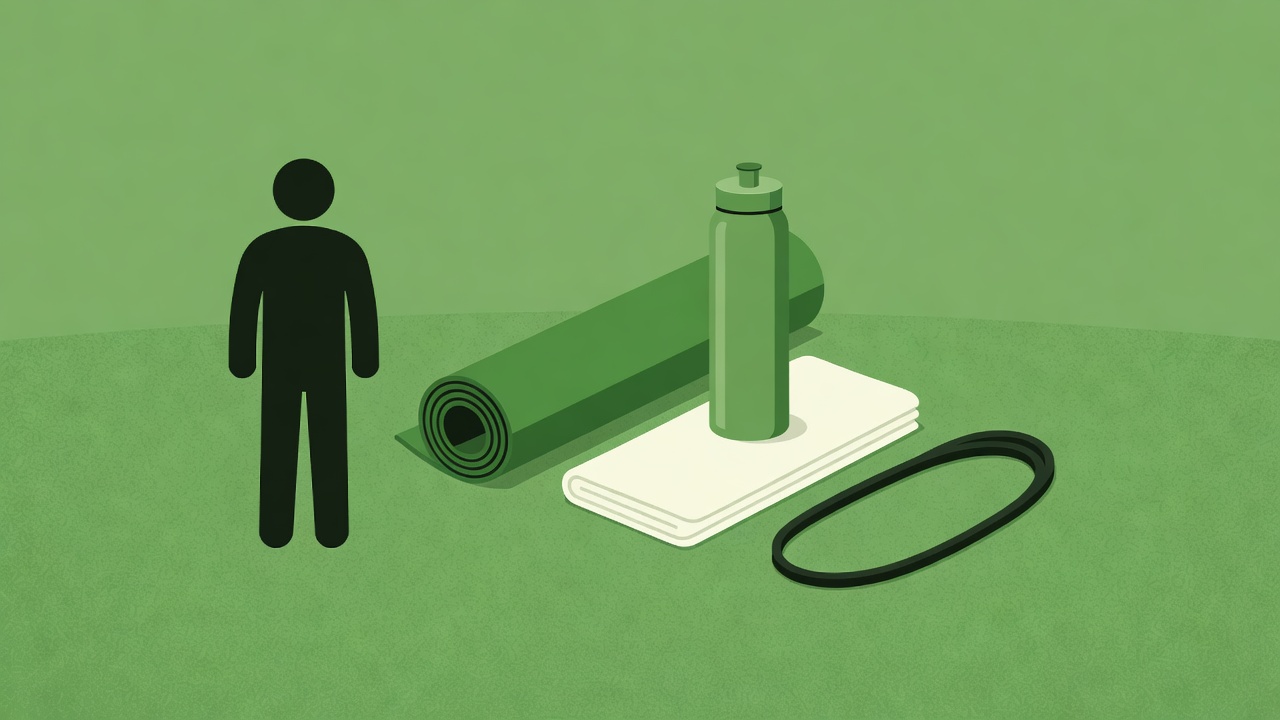
Fitness accessories are often presented as commitments: buy the kit and become the person who uses it. We take a smaller view. If you already walk, attend a class or follow a suitable home routine, an accessory should address something specific within that activity. If there is no clear inconvenience, there may be nothing to buy.
Notice the practical details around the session. Is the mat difficult to store? Does the bottle lid take too long to clean? Are you carrying a full bag for a short walk that needs very little? These questions do not measure the quality of your movement. They help identify equipment that fits the life around it.
Rank the fit, not the ambition
Appropriate mat: for a surface problem
For an activity that calls for a mat, prioritize stability, usable space and compatibility with the floor. More cushioning is not automatically better: a very soft surface can feel less stable for some movements. Follow activity-specific and manufacturer guidance.
Cleanable bottle: for convenient access
A secure lid, manageable weight and parts you can actually clean may matter more than a long feature list. An existing suitable bottle is enough if it does not leak and you can maintain it properly.
Small carry solution: for the trip there
A simple bag or strap can make a mat or change of clothes easier to transport. It ranks well only when carrying is the problem. Check that closures are secure and that straps do not snag.
Resistance band: for an established need
A band is compact, but it introduces resistance and requires suitable technique. Consider one when it is appropriate to a routine you understand, not because it is an inexpensive substitute for guidance.
Surface, grip and storage come together
Before choosing a mat, measure both the activity area and its storage space. Check whether doors can open and whether nearby furniture creates a collision risk. A mat that is awkward to unroll in your actual room may remain unused regardless of its material or appearance.
Try an existing towel only where it is suitable and will not slide; it is not a universal replacement for a purpose-designed mat. Keep the surface clean and dry, and check both sides for wear. For any equipment, the manufacturer’s use and care instructions are more useful than a generalized claim that one material is best for everyone.
Useful when
The accessory removes a known obstacle from an activity you already do and has a realistic storage place.
Less useful when
It requires an entirely new routine, creates extra cleaning or duplicates equipment that works.
Maintenance belongs in the decision
| Accessory | Portability | Care and inspection |
|---|---|---|
| Exercise mat | Check rolled size and carrying method | Clean as directed; dry before storing; check grip and damage |
| Refillable bottle | Check filled weight and bag-pocket fit | Wash accessible parts; inspect seals; dry fully |
| Resistance band | Compact, but protect it from abrasion | Inspect for cracks, tears and deterioration before use |
| Carry bag | Match capacity to the actual kit | Air after use; clean according to the label |
Know what a gadget cannot tell you
Wearable trackers and app-connected accessories can provide prompts or estimates, but they are not prerequisites for movement. A simple timer may cover the same practical need without an account, charging routine or additional personal data. If you consider a connected device, review permissions, data sharing and export or deletion options as carefully as battery life.
Do not treat a consumer gadget’s reading as a diagnosis or a personalized training instruction. The World Health Organization’s physical activity information and CDC physical activity resources offer general context. The NHS exercise resources can also be useful. Individual needs, disabilities, injuries and health conditions require context these product guides cannot provide.
Keep the smallest useful kit ready
Choose a convenient, dry place for the items you genuinely use. Return them there after cleaning. If your familiar activity needs only comfortable clothing, suitable footwear and access to water, there is no reason to add a dedicated accessory collection. A kit should not become another task you need motivation to complete.
Resistance bands deserve particular care: follow the maker’s instructions, respect any latex or material allergy warnings, and do not use damaged bands or improvised attachment points. Stop an activity that causes pain or concerning symptoms and seek appropriate advice. Equipment is not a safeguard against doing an unsuitable exercise.
After several ordinary sessions, review what actually helped. Keep the bottle that is easy to open and clean. Reconsider the bulky carrier that never leaves the cupboard. An accessory earns its place by being useful in practice, not by making the routine look more serious.